Agentic AI: Creating Real Value for Organizations

Emran A. Hamdan | Advisory & Architecture Consultant
AI Architecture
10
min read

Artificial Intelligence (AI) is often described in broad, sometimes conflicting terms. For many people, the arrival of Generative AI (GenAI)—powered by both closed-source and open-source Large Language Models (LLMs)—has simply meant a better way to find answers. Unlike traditional search engines, these models can deliver more relevant results, adapt their responses to your preferred style, and even generate structured data or functional code snippets for technical users.
Today, GenAI excels at helping individuals. But what about organizations?
Enterprises—whether small, medium, or large—store vast amounts of information in data lakes, relational databases, spreadsheets, BI cubes, documents, and presentations. How can AI bring the same transformative capabilities into these complex, multi-source environments?
The Role of RAG in Unlocking Enterprise Data
One of the key enablers is Retrieval-Augmented Generation (RAG). By combining LLMs with real-time access to updated enterprise data, RAG improves accuracy and relevance beyond what static, pre-trained models can deliver. Early in the GenAI era, many doubted this approach—but it’s now proving to be a game-changer for enterprise search and knowledge retrieval.
Still, the real question is: How can organizations truly benefit from AI beyond generic productivity gains?
We’ve already seen the value of AI in accelerating research, producing marketing content, generating visuals, and condensing time-intensive tasks. But the next leap—Agentic AI—promises to go further: AI systems that work autonomously, operate around the clock, and solve real-world business problems.
The Promise and Reality of Agentic AI
Search for “Agentic AI” and you’ll find bold claims about replacing human work. While some capabilities are real—especially in content creation—AI agents still have limitations. Organizations shouldn’t jump into deploying them without a clear roadmap and measurable goals.
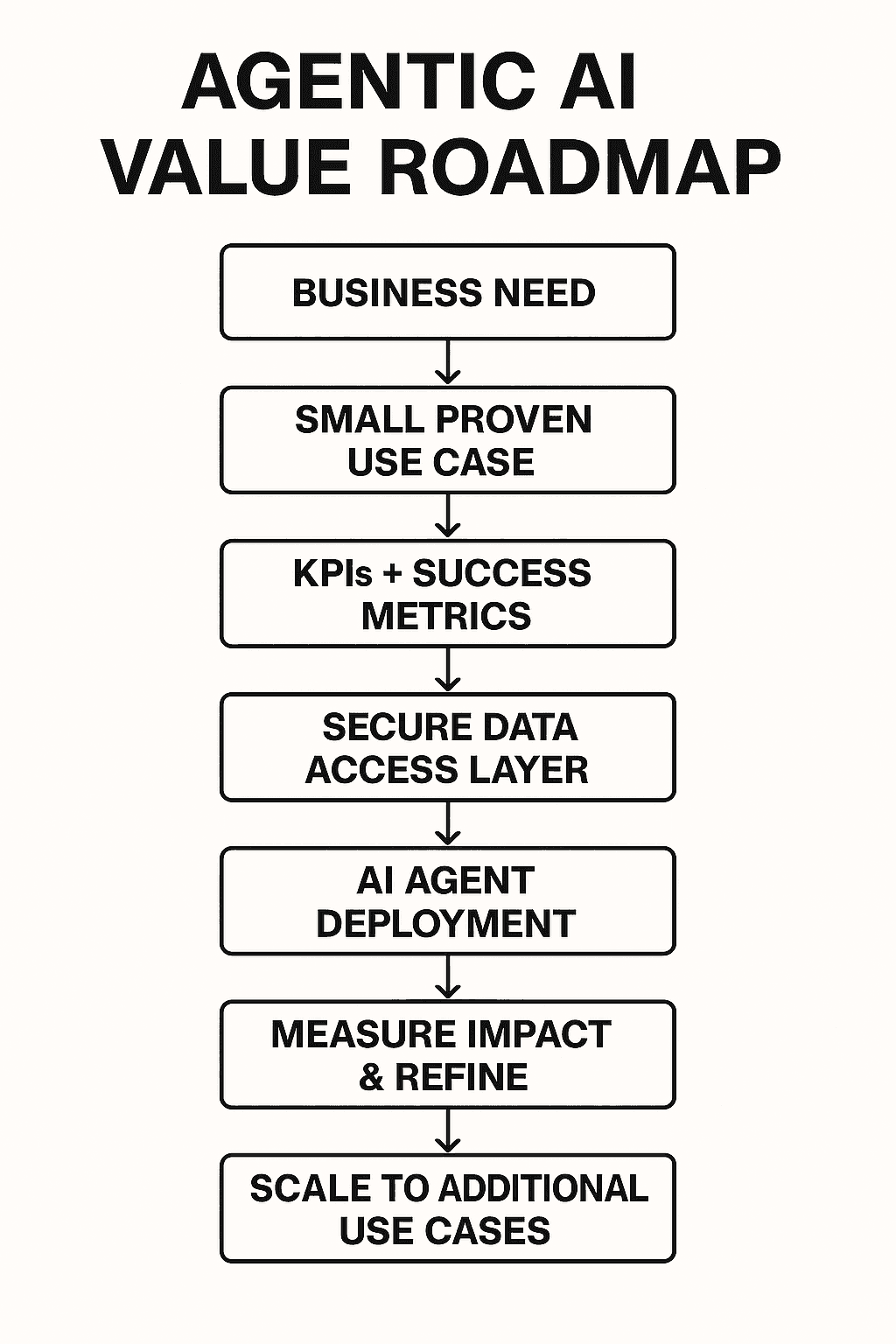
An AI agent project should start with:
A small, well-defined goal
Clear KPIs and success metrics
An agreed timeframe and resource allocation
A tracking sheet for wins, losses, and lessons learned
This disciplined approach helps avoid wasted effort and ensures that AI projects deliver tangible value.
In my view, organizations beginning their AI journey should focus on proven, high-maturity use cases—solutions that have worked in similar contexts—before experimenting with more advanced or experimental applications.
Frameworks and Tools for AI Agents
Frameworks like LangGraph have pioneered the foundational concepts for AI agent orchestration, though they require a steep learning curve. Low-code alternatives such as CrewAI are emerging as attractive options for faster prototyping and experimentation.
But regardless of the framework, AI agent projects face common challenges:
Data Access: Who authorizes LLMs to use sensitive enterprise data?
Security: How do we enforce governance and discipline in AI data handling?
Data Integration: How will agents interact with structured and unstructured data?
Protocol Choice: Should we adopt the MCP protocol, tool/function calling, or other standards?
Output Validation: Who checks the results—another AI agent, or a human?
Scalability Strategy: How will the solution evolve once successful?
Human Oversight: When and where should humans intervene—pre-agent, post-agent, or both?
A Solution Architect’s Perspective
Many skilled AI developers and data engineers excel at using new tools but often lack the system-level discipline that ensures solutions are secure, maintainable, and aligned with enterprise architecture.
From a solution architecture standpoint:
AI agents should function as an access layer—not as a replacement for core systems.
This means preserving existing APIs, data access rules, and security controls.
AI integration should follow prototyping and MVP principles, avoiding the temptation to over-invest in flashy UIs before validating business impact.
Every deployment should be tied to a value map—a direct link between the AI agent’s function and measurable improvements for end users, customers, or business partners.
Agentic AI has enormous potential—but only if approached with clear objectives, robust governance, and a focus on real business outcomes. Organizations that take a structured, value-driven approach will be the ones to turn the promise of AI agents into lasting competitive advantage.
Want to know more about how Innvatio.io can help?
📧 info@innvatio.io

Let's Talk
We turn gaps into growth with smart workflows and practical automation
Stay informed with the latest guides and news.